
Gozan no Okuribi: The Complete Guide to the Fires of Prayer

Kyoto’s summers are long and demanding. Once the heat of the Gion Matsuri fades in early August, a quiet, solemn atmosphere settles over the city. For those who call Kyoto home, the most significant event marking the end of summer is Gozan no Okuribi (The Five Mountain Send-off Fires), held every year on the night of August 16th.
Enormous characters and shapes burn crimson against the canvas of the night sky. While this is a famous seasonal tradition that attracts many, its true depth lies in its meaning, history, and the devotion of the local people. This guide covers everything from its origins and the characteristics of each mountain to viewing tips and essential etiquette.
What is Gozan no Okuribi? Its True Meaning and Origins

The most important thing to understand is that Gozan no Okuribi is not a tourist event or a festival. It is a strictly solemn and sacred Buddhist ritual known as Seirei-okuri (Spirit Send-off). It is performed to guide the spirits of ancestors—affectionately called Oshorai-san in Kyoto—back to the afterlife after they have spent the O-bon period visiting their family homes.
The exact origins remain a bit of a mystery, with no official records. Legends suggest it was started by Kobo Daishi (Kukai) in the Heian period, or perhaps by Ashikaga Yoshimasa in the Muromachi period, or that it became a common practice among townspeople in the early Edo period. While there were once over ten fires—including shapes like snakes or longswords—it eventually settled into the five mountains we see today. Though shrouded in historical romance, the act of "prayer" has remained unbroken through the centuries.
The Five Fires: Characteristics and Lighting Times
Starting at 8:00 PM on August 16th, the fires are lit one by one in a clockwise direction from east to west.
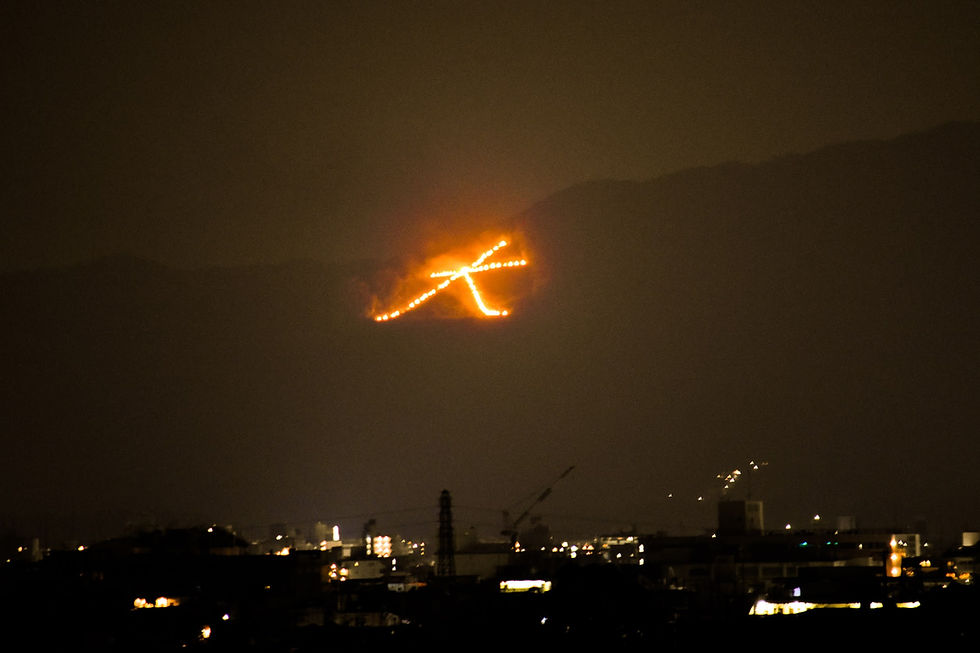
20:00 | Daimonji (East Mountain / Nyoigadake) The most famous of the five, visible from a wide area of the city. It forms the character Dai (meaning "Large" or "Great"). It features 75 firebeds. The moment the character suddenly emerges from the darkness is breathtakingly beautiful.
20:05 | Myo-Ho (Matsugasaki / West & East Hills) Five minutes later, the characters Myo and Ho are lit simultaneously. These refer to the Buddhist lotus sutra (Nam-myoho-renge-kyo). These characters are notably powerful, with 103 firebeds for Myo and 63 for Ho.
20:10 | Funagata (Nishigamo / Mt. Myoken) This takes the shape of a boat (funa). It represents the "Spirit Boat" carrying ancestors to the Western Pure Land. Legend says it commemorates the monk Ennin’s safe return from China during a storm. The bow of the boat points west.
20:15 | Hidari Daimonji (Mt. Dai-hokusan) Located just north of Kinkaku-ji Temple, it is called the "Left" (West) Daimonji to distinguish it from the one in the east. They strictly follow a tradition of lighting a sacred fire at the foot of the mountain and carrying it to the summit to ignite the 53 firebeds.
20:20 | Toriigata (Saga / Mt. Mandara) The grand finale is the shape of a Torii (shrine gate). It has 108 firebeds, matching the number of human worldly desires (bonno). Unlike the other mountains that use stacked wood (igeta), this one uses torches (taimatsu) thrust directly into the ground, creating a unique visual effect.
Where to Watch: Recommended Viewing Spots

Since Kyoto is a basin surrounded by mountains, you can see the fires from many spots if high buildings aren't in the way.
Daimonji: Banks of the Kamo River (between Marutamachi Bridge and Misono Bridge), or the Kyoto Gyoen National Garden.
Myo-Ho: Kitayama-dori Street or the banks of the Takano River.
Funagata: Kitayama-dori Street (northwest of Kitayama Ohashi Bridge).
Hidari Daimonji: Nishioji-dori Street (from Saiin toward Kinkaku-ji).
Toriigata: Near Togetsukyo Bridge in Arashiyama or Hirosawa Pond.
For the full view: Funaoyama Park is a famous "secret" spot where you can see four of the mountains (except Toriigata) from near the summit.
The Grit and Passion Behind the Flames
Everything is Done by Hand
In our age of technology, you could light these with a single switch. But Gozan no Okuribi uses no electronic igniters. Members of the local preservation societies stand by each firebed with torches and ignite them all at once upon a signal. The precision required to make a massive character appear perfectly in seconds is nothing short of god-tier craftsmanship.
Staggering Heat and Intensity
From afar, they look like quiet lights. On the mountain, it is a war zone of fire. Flames reach heights of 2 to 3 meters, with intense smoke and the roar of crackling wood. Preservation members work amidst a rain of sparks to maintain the shape of the character. This "prayer" is sustained by people who literally risk their safety to keep the fire alive.
The Preservation Societies
These are groups of local residents who protect the tradition. Their work isn't just one night; they maintain the mountain trails year-round and, in the blistering summer heat, carry dozens of kilograms of firewood up the steep slopes on their own backs. Their sense of duty to "never let the ancestral fires die" is the backbone of the event.
How You Can Participate: Gomagi (Votive Sticks)
Even visitors can offer a prayer through Gomagi.
When: August 15th and 16th (some spots start earlier).
Where: At the foot of the mountains (e.g., in front of Ginkaku-ji, Kinkaku-ji, or local temples).
How: For a small donation (a few hundred yen), you write your name, your ancestors' names, or a wish (like "Good Health") on a wooden stick. These sticks are carried to the summit and burned in the firebeds on the night of the 16th. Watching the flames rise, knowing your prayers are part of that massive fire, is a deeply moving experience.
Charms for Protection: The "Karakeshi" Tradition
Kyoto locals believe the fires bring protection from illness. A famous folk belief says that if you reflect the flames in a cup of sake or water and drink it, you will be protected from strokes and paralysis.
Furthermore, there is the custom of Karakeshi (charred embers). At dawn on August 17th, locals climb the mountains to collect the remaining charcoal from the firebeds. Wrapped in white paper and tied with a ritual cord, these are hung at the entrance of homes as powerful charms against evil, thieves, and house fires. If you look at the eaves of old Kyoto townhouses, you will often see these handmade charms hanging there.
Crucial Etiquette for Visitors
Remember, it is a Prayer: This is not a party or a fireworks display. It is a sacred funeral rite. Please refrain from cheering or clapping when the fires are lit. Instead, join your hands in silent prayer.
Drones are Strictly Prohibited: They are dangerous and interfere with the sacred atmosphere. Flying drones is illegal and strictly enforced.
Be Careful with Flash Photography: Do not point high-powered flashes at the mountains. It can blind the workers on the steep slopes, potentially causing serious accidents.
Use Public Transport: Massive traffic restrictions will be in place. Avoid cars and stick to the subway or buses.
Knowing the backbreaking manual labor, the year-round devotion of the preservation societies, and the deep-rooted faith of the locals transforms Gozan no Okuribi from a visual spectacle into a profound spiritual experience. This August 16th, find a quiet spot, look up at the night sky, and offer a silent prayer to the majestic flames.


Comments