
A must-see for Arashiyama sightseeing: Ryoan-ji Temple, a World Heritage Site. Experience the tranquility of Zen and a thousand years of history through its rock garden.
- くまCEO
- 2 days ago
- 9 min read
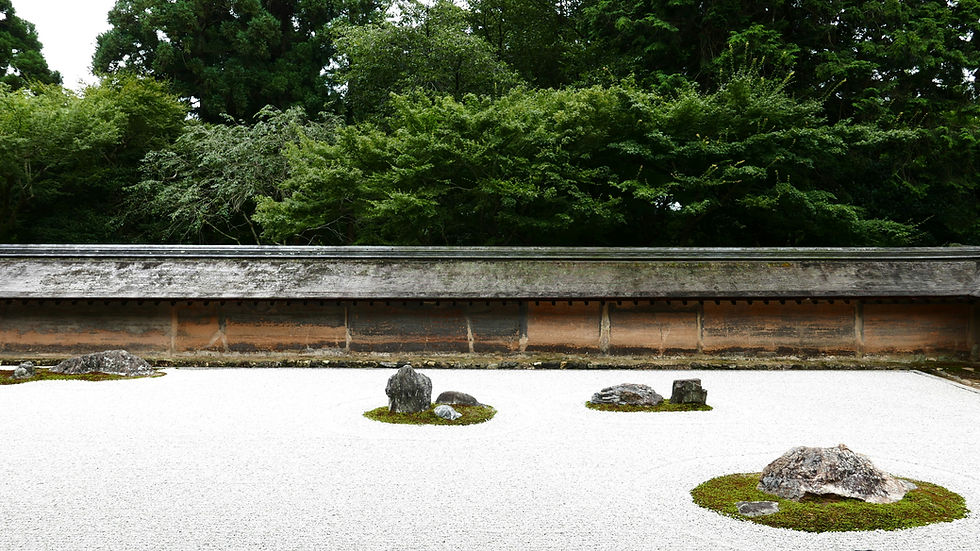
If you're looking for a peaceful break during your Arashiyama sightseeing, Ryoan-ji Temple, a World Heritage Site, is definitely a place you should consider. Known for its iconic rock garden, Ryoan-ji Temple offers a tranquil Zen atmosphere, quite different from the bustling Arashiyama area. After enjoying the bamboo grove and Togetsukyo Bridge, spending some time at Ryoan-ji Temple to calm your mind will deepen your impression of your Kyoto trip.
What kind of temple is Ryoanji, which is worth visiting after extending your trip from Arashiyama?
Ryōan-ji Temple, nestled quietly at the foot of Mount Kinugasa, is a Zen Buddhist temple belonging to the Myōshin-ji branch of the Rinzai school. Registered in 1994 as one of the constituent assets of the UNESCO World Cultural Heritage site "Historic Monuments of Ancient Kyoto," it is one of Kyoto's most representative temples, attracting many tourists from both Japan and abroad.
Ryōan-ji is most famous for its "rock garden" (a dry landscape garden). Why does this simple garden, consisting of only 15 stones placed on white sand, attract so many people? The answer can be felt not through words or explanations, but by actually sitting in front of the rock garden at Ryōan-ji and spending some time there.
While many Arashiyama tourists visit famous spots such as the bamboo grove, Togetsukyo Bridge, and Tenryū-ji Temple, extending your trip a little further to Ryōan-ji Temple will reveal another charm of Kyoto. The space of Ryōan-ji, embodying the worldview of Zen, leaves a quiet and lingering impression on the hearts of visitors.
In addition to the rock garden, the temple grounds offer plenty of other attractions, including a vast pond garden centered around Kyoyo Pond and lush, green pathways. If you're planning to visit Kyoto along with Arashiyama, Ryoan-ji Temple is a place I highly recommend visiting and taking your time to explore.
The History of Ryoan-ji Temple: From a Nobleman's Villa to a Renowned Zen Temple
The history of Ryōan-ji Temple dates back to the late Heian period. Originally, this land was a villa site for the Tokudaiji family, descendants of the Fujiwara clan. The foot of Mount Kinugasa, blessed with the beauty of nature throughout the seasons, was a scenic area beloved by Heian aristocrats. It is said that mandarin ducks migrated to Kyōyō Pond, and the aristocrats enjoyed its beauty.
Later, in 1450 (Hōtoku 2), shortly before the Ōnin War (1467-1477), Hosokawa Katsumoto, a powerful daimyo at the time, donated this land to the Zen monk Giten Genshō, and Ryōan-ji Temple was founded as a Zen temple.
However, shortly after its founding, Hosokawa Katsumoto himself became the commander-in-chief of the Eastern Army in the Ōnin War. During this period of war, Ryōan-ji Temple suffered the tragedy of being destroyed by fire, and was later rebuilt in 1488 (Chōkyō 2) by Hosokawa Masamoto.
To this day, there are no clear records of when or by whom the Ryōan-ji Temple rock garden was created. Several theories exist, including that it was created by Tokuhō Zenketsu, by Sōami, or by the gardeners Kentei and Zenjirō. This mysterious origin further deepens the mystique of the Ryōan-ji Temple rock garden.
The names "Kotarō and Seijirō" have been discovered inscribed on one of the stones in the arrangement, and it is thought that these may be the names of the craftsmen involved in the landscaping, but the details remain a mystery.
During the Edo period, it received patronage from the Tokugawa family and underwent several restorations to reach its current form. Having survived the anti-Buddhist movement of the Meiji era, and after being registered as a World Heritage Site in 1994, Ryoan-ji Temple continues to exist today.
The Stone Garden of Ryoan-ji Temple | A Mysterious World That Even Queen Elizabeth Was Enchanted By

In 1975, Queen Elizabeth II of England visited Ryōan-ji Temple and was deeply impressed by its rock garden, which significantly contributed to spreading the temple's name worldwide. Since then, the Ryōan-ji rock garden has become internationally recognized as one of Japan's most representative gardens, and is a popular Kyoto landmark attracting tourists from overseas.
The Ryōan-ji rock garden is a rectangular space approximately 25 meters east-west and 10 meters north-south, covered with white sand. Fifteen stones of varying sizes are arranged on this sand, divided into five groups. The moss-covered stones are arranged in such a way that, from any viewing angle, one stone is always hidden from view, making it impossible to see all 15 stones simultaneously.
In the world of Zen, "15 is considered a perfect number," and this design, which prevents viewing all stones, is interpreted as embodying the Zen philosophy that "human beings are never perfect." The Ryōan-ji rock garden is not only beautiful, but also a garden that offers viewers space for reflection.
The white sand is meticulously adorned with sand patterns, the wave-like lines evoking images of the ocean or a sea of clouds. While some say the stones represent islands and the sand represents the sea, Ryoan-ji Temple values the principle of "let each viewer interpret it freely," and therefore does not offer an official explanation of the garden's meaning. This further highlights the profound depth of Ryoan-ji's rock garden.
Sitting on the veranda and gazing at Ryoan-ji's rock garden, one feels a sudden slowing of time, a stark contrast to the hustle and bustle of Arashiyama and other tourist spots in Kyoto. Visiting Ryoan-ji in the morning, right after opening, is especially recommended, as there are fewer people and the sand patterns are beautifully maintained for a more complete and enjoyable experience.
Highlights of Ryoan-ji Temple grounds to enjoy along with sightseeing in Arashiyama

Kyoyo Pond and the pond garden, a vast landscape colored by the four seasons
Before heading to the rock garden at Ryoan-ji Temple, you should definitely stop and admire the pond garden centered around Kyoyo Pond. Upon entering the temple grounds from the approach, this large pond is the first thing that catches your eye.
It has a history of being a place where aristocrats released mandarin ducks for enjoyment during the Heian period, and even today, it displays beautiful scenery throughout the seasons: cherry blossoms in spring, lotus flowers in summer, and autumn leaves in fall. A walking path is maintained around the pond, allowing you to enjoy a garden world that offers a different kind of natural richness compared to Ryoan-ji's rock garden.
Visiting Ryoan-ji after enjoying the natural scenery of Arashiyama offers a more tranquil and peaceful atmosphere, even though it's still part of Kyoto's natural landscape.
The teaching of contentment inscribed on Ryoan-ji's tsukubai (stone basin):
In front of the tea room "Zoroku-an," located northwest of the Hojo (abbot's quarters), is a water basin called the "Chisoku no Tsukubai" (the water basin of contentment). This tsukubai (stone basin) is inscribed with the Zen phrase "I only know contentment" (吾唯足知), centered around the character "口" (mouth), and its unique design is striking.
It embodies the fundamental Zen teaching of "being grateful for what you have and knowing contentment," and, alongside the rock garden, has become a symbol of Ryoan-ji Temple. It is said to have been donated by Tokugawa Mitsukuni, also known as Mito Komon.
When visiting Ryoan-ji Temple, be sure to pay attention not only to the rock garden but also to this tsukubai. The essence of Zen philosophy is condensed into these short words.
The Hojo (abbot's quarters) and the Zen atmosphere of Ryoan-ji Temple
The veranda from which you can admire the rock garden up close is adjacent to the corridor of the Hojo. The Hojo itself was rebuilt during the Edo period, and its interior houses portraits of people closely associated with Ryoan-ji Temple, as well as fusuma paintings by the Kano school.
The charm of Ryoan-ji Temple is not limited to the rock garden. The serene Zen atmosphere that permeates the entire temple grounds can be fully appreciated simply by walking around the Hojo (abbot's quarters). For those who want to calm their minds in a quiet place amidst sightseeing in Arashiyama, Ryoan-ji Temple is the perfect spot.
Tourist attractions around Ryoanji Temple, starting from Arashiyama

Ryōan-ji Temple is located along Kinukake-no-michi, a street lined with World Heritage sites, and several famous tourist attractions are within walking distance. Even when combining it with Arashiyama sightseeing, you can efficiently visit multiple spots in one day by carefully planning your itinerary.
Ninna-ji Temple is the head temple of the Omuro branch of Shingon Buddhism, located about a 10-minute walk west of Ryōan-ji Temple. It is famous for its late-blooming cherry blossoms, known as "Omuro no Sakura," and is a UNESCO World Cultural Heritage site. The temple grounds feature important cultural properties such as the Niomon Gate and the five-story pagoda, offering a spectacular view that is quite different from Ryōan-ji.
Kinkaku-ji Temple (Rokuon-ji Temple) is located about a 15-minute walk east of Ryōan-ji Temple. The sight of the gold-leafed Shariden (reliquary hall) reflected in Kyōko-ike Pond is a breathtaking view that is considered a symbol of Kyoto tourism. Ryōan-ji and Kinkaku-ji are connected by a single bus, making it a very popular route for tourists visiting both.
Myoshin-ji Temple is the head temple of the Myoshin-ji branch of the Rinzai school of Zen Buddhism, located immediately south of Ryoan-ji Temple. Ryoan-ji is one of its sub-temples. Numerous sub-temples are scattered throughout the vast grounds, and during special public viewing periods, visitors can admire the national treasure bell and the "Cloud Dragon" painting on the ceiling of the main hall.
A recommended sightseeing route, starting from Arashiyama, visiting Ryoan-ji, and then continuing to Ninna-ji and Kinkaku-ji, allows you to enjoy Kyoto's rich history and garden culture all at once.
Ryoanji Temple's visiting hours and admission fee
The visiting hours for Ryoan-ji Temple vary depending on the season.
From March 1st to November 30th, the hours are from 8:00 AM to 5:00 PM. From December 1st to the end of February, the hours are from 8:30 AM to 4:30 PM. The last admission is 30 minutes before closing time, so it's recommended to visit with plenty of time to spare.
Admission fees are 600 yen for adults, 500 yen for high school students, and 300 yen for elementary and junior high school students. Group discounts and disability discounts are available; please check in advance if applicable. Fees are subject to change, so please check the official website for the latest information before visiting Ryoan-ji Temple.
To avoid crowds, it's recommended to visit early in the morning right after opening or in the evening 1-2 hours before closing. Ryoan-ji Temple and surrounding tourist attractions are especially crowded during cherry blossom and autumn foliage seasons. If you are visiting on the same day as Arashiyama, a good route would be to visit Ryoan-ji Temple in the morning and then move on to Arashiyama.
Access to Ryoanji Temple, which is also easily accessible from the Arashiyama area.
Access by train
If you're using the Keifuku Electric Railway, commonly known as Randen, the nearest station is "Ryōanji Station." It's about 30 minutes from Shijō-Ōmiya Station and about 20 minutes from Arashiyama Station. From the station to the main gate of Ryōanji Temple is about a 7-8 minute walk.
If you're going to Ryōanji Temple from Arashiyama, using Randen allows you to enjoy the scenery while traveling. The retro atmosphere of the train and the scenic route connecting Arashiyama and Ryōanji Temple are part of its charm.
If you're using the subway, it's convenient to either walk about 45 minutes from "Uzumasa Tenjingawa Station" on the Kyoto Municipal Subway Tōzai Line, or transfer to Randen and get off at "Ryōanji Station." If you're using JR, "Enmachi Station" is relatively close, and from there, it's convenient to take a city bus and get off at the "Ryōanji-mae" bus stop.
Access by bus
If you are using Kyoto City Buses, the nearest stop is "Ryōanji-mae" (Ryōanji Temple). From Kyoto Station, take bus route 50 (approximately 50 minutes). From Sanjo Keihan or Shijo Karasuma, take bus route 59.
Please note that bus travel times can vary significantly depending on traffic conditions. Especially during peak tourist seasons in Kyoto, including around Arashiyama and Kinkakuji Temple, both roads and buses tend to be congested, so it is recommended to plan your trip with ample time.
Access by taxi
From Kyoto Station to Ryoan-ji Temple, it takes approximately 30-40 minutes by taxi. The fare varies depending on traffic, but is estimated to be around 3,500-4,000 yen.
If traveling from the vicinity of Tenryu-ji Temple in Arashiyama to Ryoan-ji Temple, it takes approximately 15-25 minutes by taxi, and the fare is estimated to be around 2,500-3,000 yen. Taxis are a convenient option if you want to visit early in the morning, have a lot of luggage, or are traveling in a group.
Things to know before visiting Ryoanji Temple during your Arashiyama sightseeing trip

The rock garden at Ryoan-ji Temple is a mysterious place where its beauty gradually unfolds, not when you try to "feel something" by looking at it intently, but rather when you simply sit there without thinking, forgetting about time and gazing at it.
Put away your smartphone for a moment, and before taking pictures, confront the space of Ryoan-ji with your own eyes. The time you spend sitting in front of the rock garden itself becomes a precious experience at Ryoan-ji.
While many visitors to Arashiyama enjoy the vibrant scenery, street food, and bamboo grove walks, Ryoan-ji offers a contrasting experience of tranquility and space. When visiting Arashiyama, be sure to extend your trip a little and stop by Ryoan-ji.
The World Heritage site of Ryoan-ji remains unchanged, quietly awaiting visitors in the same place. Combining a visit to Arashiyama and Ryoan-ji will allow you to more deeply appreciate the beauty of Kyoto's nature, history, and Zen.


Comments